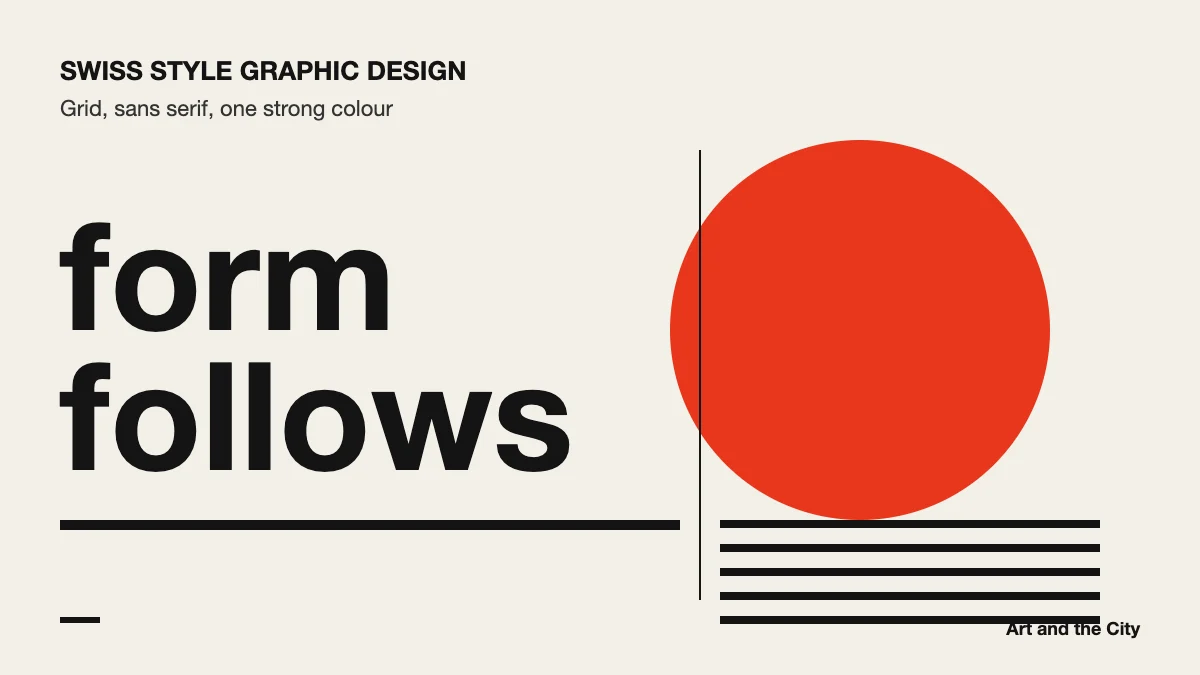
Swiss style graphic design, also called the International Typographic Style, grew in Switzerland in the 1950s. Designers in Zurich and Basel wanted design that was objective and easy to read. As a result, the style is known for clean grids, clear type and a lot of white space. These six principles still work in modern design, from posters to websites.
Looking for the difference with Bauhaus? Read Evolution of Design: from Bauhaus to Swiss Style.
1. Use a grid
Every element has its place on a grid. This gives a page structure and, in addition, makes a series of designs look related. Many Swiss designers worked with four or six columns and a fixed baseline.
2. Choose clear typography
Swiss style graphic design favors simple sans serif fonts, set flush left with a ragged right edge. Because the type is so plain, the text is easy to read and the hierarchy is clear. Akzidenz-Grotesk and later Helvetica were the classic choices.
3. Give the page white space
Empty space is part of the design. It gives the content room and guides the eye. So resist the urge to fill every corner.
4. Use photography with purpose
Images are chosen to inform, not to decorate. For example, a single strong photo often does more than many small ones.
5. Keep a strong contrast
Differences in size and weight show what matters most. Use few colors and let one of them stand out, often a bright red next to black and white.
6. Aim for objective clarity
The message comes first. Therefore, remove everything that does not help the reader understand it.
A Swiss style practice assignment
Design an A3 poster for a small event with one headline, one photo and three lines of information. Use a four column grid and one font family. Keep the text flush left. Then print it and look at it from two meters away: is the main message still clear?
Learn more about Swiss style graphic design
The overview of the International Typographic Style on Wikipedia lists the key designers, such as Josef Müller-Brockmann and Armin Hofmann. Their posters are worth studying closely. If you want to practice grid, typography and layout with feedback, join the live lessons in our online graphic design course.
