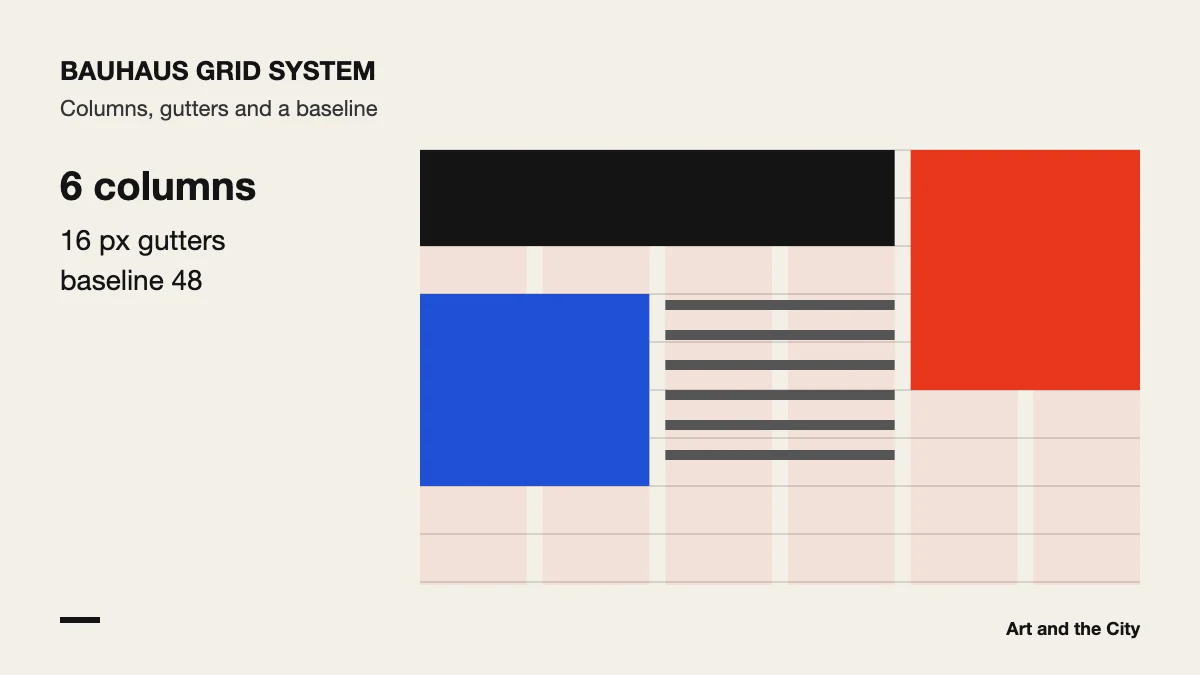
The Bauhaus grid system is a way to organise a page with a few clear lines. Bauhaus designers wanted layouts that were simple, functional and easy to read. A grid helps you do exactly that. You can use the same thinking today, on a poster, a website or a magazine page.
Want the bigger story first? Read our overview of Bauhaus, Swiss style and typographic simplicity.
What the Bauhaus grid system is
A grid is a set of invisible guides: margins, columns and rows. You place text and images on those guides. The result is order, rhythm and balance, without decoration.
Why designers still use it
A grid saves time and makes decisions easier. It keeps pages consistent and it helps the reader to find their way. Bauhaus ideas such as function first and no unnecessary ornament are still a good rule for modern layouts.
How to build a simple grid
- Choose the format, for example A4 or a square social post.
- Set the margins. Keep them generous.
- Divide the page into two, three or four columns.
- Add horizontal guides for the headline and the image area.
- Place every element on the guides. Let some columns stay empty.
Use contrast, not decoration
Bauhaus layouts often use a strong difference in size, weight and colour. One large headline, one image and a few lines of text can be enough. Limit yourself to two or three colours and one or two fonts.
A short exercise
Take a poster you like and draw the grid on top of it. Count the columns. Look at where the headline sits and which spaces stay empty. Then design your own version of the poster on the same grid.
Where to go next
You practise grids, typography and composition with feedback from a teacher in our online graphic design course.
For background on the school itself, the Bauhaus article on Wikipedia gives a clear timeline from Weimar to Dessau and Berlin. Once you know the history, the Bauhaus grid system makes even more sense: it was part of a wider idea that form should follow function.